AI is becoming more useful across fashion and apparel, but the quality of AI’s work depends on what the AI can actually see. A model may understand the principles of inventory planning or wholesale operations, but it cannot tell a team which styles are running low, which orders are at risk, or which customers have overdue balances unless it can reach the systems where that information resides.
For fashion companies, the challenge is connecting AI with their ERP and product, inventory, order, customer, purchasing, fulfillment, and financial data already used to run the business, because this data may live siloed across several systems. Without a connection, teams are left exporting reports, uploading files, and repeatedly explaining business context to separate AI tools.
Model Context Protocol, or MCP, is one way to create that connection.
What Is MCP in Apparel?
Model Context Protocol (MCP) is an open standard that gives compatible AI applications a structured way to connect with external data, tools, and business systems.
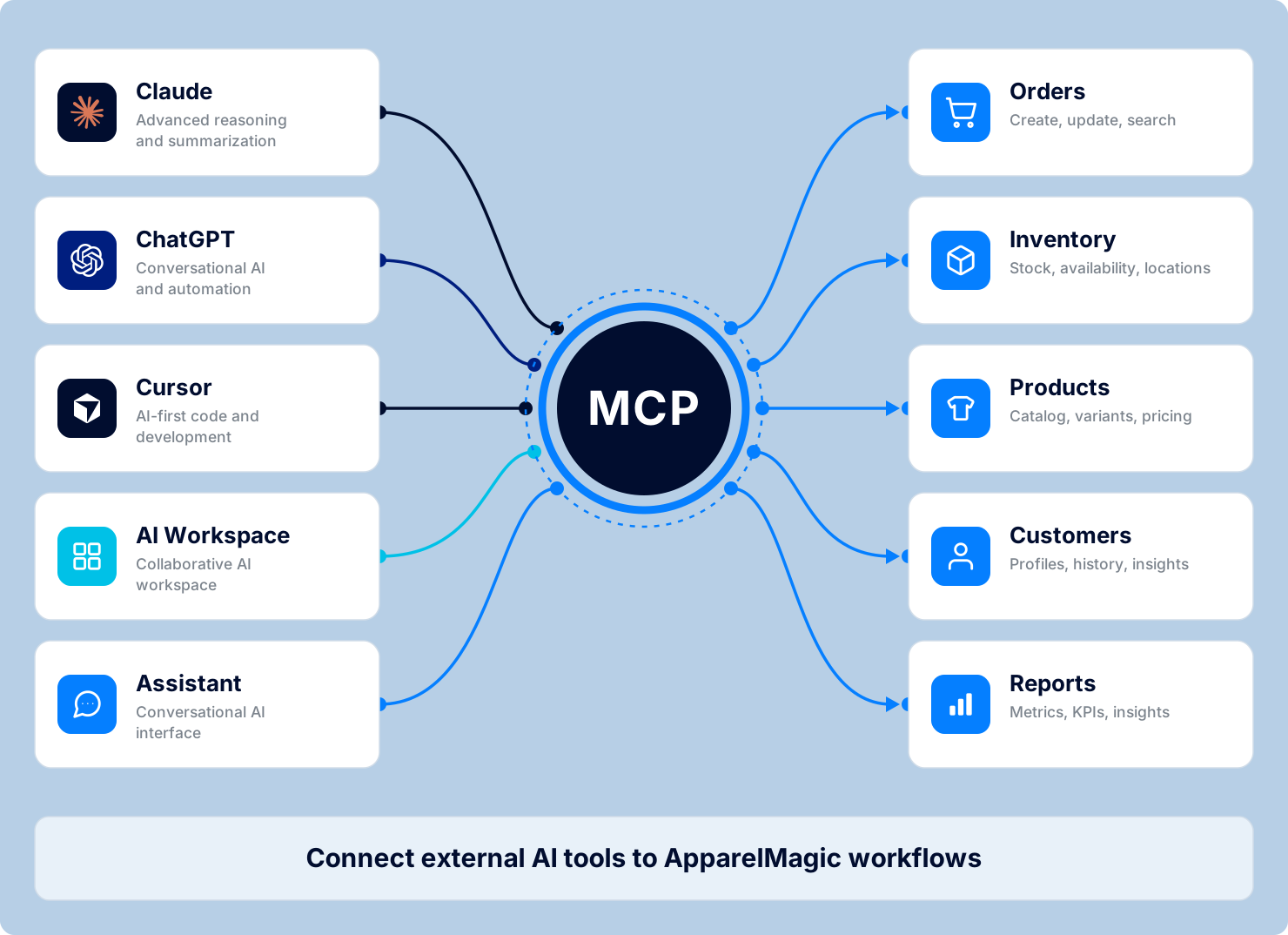
For an apparel company, that can mean giving an approved AI application various levels of access to operational context such as styles, colors, sizes, inventory by warehouse, sales orders, purchase orders, customers, costs, margins, and product development data.
Instead of exporting that information into an AI tool every time someone needs to ask a question, an MCP-enabled system can make approved data and capabilities available through a structured connection. The AI can then work with current business context while the underlying systems remain the source of record.
Which AI Platforms Work With MCP?
MCP is not designed around one AI company or one model. It can be used across a growing range of compatible AI applications and development environments.
That includes products across the Claude, ChatGPT, Microsoft Copilot, Gemini, Cursor, and Visual Studio Code ecosystems, although the exact connection method and supported capabilities depend on the product, plan, authentication method, and MCP implementation.
For fashion companies, the broader advantage is flexibility. Business software can expose approved capabilities through a common protocol rather than requiring a completely different AI-specific connection every time a new assistant, agent, or AI environment enters the technology stack.
Why MCP Matters for Fashion and Apparel
Apparel questions rarely exist in isolation. Understanding the position of one style may require its color and size variants, inventory across warehouses, committed quantities, incoming purchase orders, recent demand, and customer obligations.
The same is true across other areas of the business. A sales question may depend on customer history and seasonal buying patterns, while a margin question may require cost, pricing, discounts, freight, and returns.
That is why connected context matters. MCP gives compatible AI tools a structured way to work across the approved relationships already maintained by the business instead of relying on one report or isolated record at a time.
What Apparel Data Can MCP Make Available to AI?
What an AI tool can use depends on the connected system, but an apparel MCP implementation may expose information across areas such as:
- Styles, SKUs, colors, and sizes
- Inventory by warehouse
- Available and committed quantities
- Open sales and wholesale orders
- Incoming purchase orders
- Vendor and production information
- Customer and account activity
- Prices, costs, and margins
- Shipment and fulfillment status
- Product development and PLM data
The important distinction is that MCP can expose the relationships between those records, not just isolated data points. A low-stock SKU, for example, becomes more meaningful when the AI can also see the orders consuming that inventory and the purchase orders expected to replenish it.
Connecting AI to ERP Data Also Means Controlling Access
The more useful AI becomes, the more important permissions become.
A warehouse employee may need inventory and order information but should not necessarily see company-wide margins. A salesperson may need customer history without access to vendor costs. Some users may only need to retrieve information, while others may be allowed to create or update records.
An MCP implementation therefore needs to be evaluated on more than connectivity. Authentication, user permissions, read-versus-write access, approvals, token management, and auditability all determine how safely AI can fit into the existing operating model.
This becomes especially important when AI moves from answering questions to taking actions. The important questions become not only “What can the AI access?” but also “Who is asking, what are they allowed to see, and what are they allowed to change?”
What Does MCP Look Like During an Apparel Workday?
Consider an inventory manager starting the day with a question about a key style.
Without connected context, they may need to open the ERP, check inventory by warehouse, review committed sales orders, compare incoming purchase orders, and then bring those results into another tool for analysis.
With the right operational context available through MCP, the interaction can begin with the question itself: “Which styles are most likely to run short before incoming inventory arrives, and which customer orders are affected?”
The value is not that AI suddenly understands inventory better. It is that the AI can work with the inventory, orders, commitments, locations, and incoming supply required to answer the question in context.
The same approach can extend across the business. A salesperson could ask which customers have reduced their order frequency, finance could review customers with overdue balances and active orders, and a merchandiser could compare sales performance, current inventory, and margin without first assembling several separate reports.
How Is MCP Different From an API?
Fashion brands already rely on APIs to connect systems such as ecommerce platforms, warehouses, accounting tools, and other parts of the technology stack. MCP does not replace those integrations.
APIs are typically used for direct system-to-system data exchange and actions, such as sending Shopify orders into an ERP or updating inventory from a warehouse. MCP serves a different purpose by giving compatible AI applications a standardized way to discover and work with approved data and capabilities from those systems.
In practice, the two can work together. Existing APIs can continue powering the integrations that move data between systems, while MCP gives AI assistants and agents a structured way to work with the business context those systems already contain.
What Should Fashion Companies Look for in MCP-Enabled Software?
For fashion companies, a useful MCP implementation should do more than connect an AI tool to a database. It should preserve the relationships that matter in apparel operations, such as how styles connect to colors and sizes, how inventory relates to warehouse availability and open orders, and how purchase orders affect future supply.
The source system also needs to be reliable enough for AI to work from it. Product, inventory, customer, purchasing, and financial information should be current and structured, with clear controls over which users can see or change specific records.
Fashion brands should also consider how far the connection can extend into actual workflows. Answering questions is useful, but an MCP implementation becomes more valuable when approved AI tools can also work with the reports, records, and actions teams already use to run the business.
The goal is not simply to give AI more data, but to give it useful access to the systems and workflows behind day-to-day apparel operations.
Where ApparelMagic MCP Fits
ApparelMagic brings MCP to fashion brands through the broader ApparelMagic Intelligence suite, extending AI capabilities into the ERP and PLM environment teams already use to manage day-to-day operations.
ApparelMagic MCP lets compatible AI tools work directly with supported ApparelMagic data and capabilities, giving teams another way to query and work with the information already inside the platform.
For example, users can ask about orders, inventory, customers, products, or other operational records from a compatible AI tool without first exporting reports or rebuilding the business context manually.
Final Thoughts
MCP becomes especially relevant to fashion when AI needs to move beyond general industry knowledge and work with the actual conditions inside a brand.
Apparel operations depend on relationships between products, inventory, demand, customers, purchasing, fulfillment, and finance. MCP gives compatible AI tools a structured way to work with that connected business context without requiring teams to repeatedly export data or rebuild it by hand.
It does not replace the ERP, existing integrations, or the people making operational decisions. Instead, it creates a connection layer that brings AI closer to the systems already running the business.