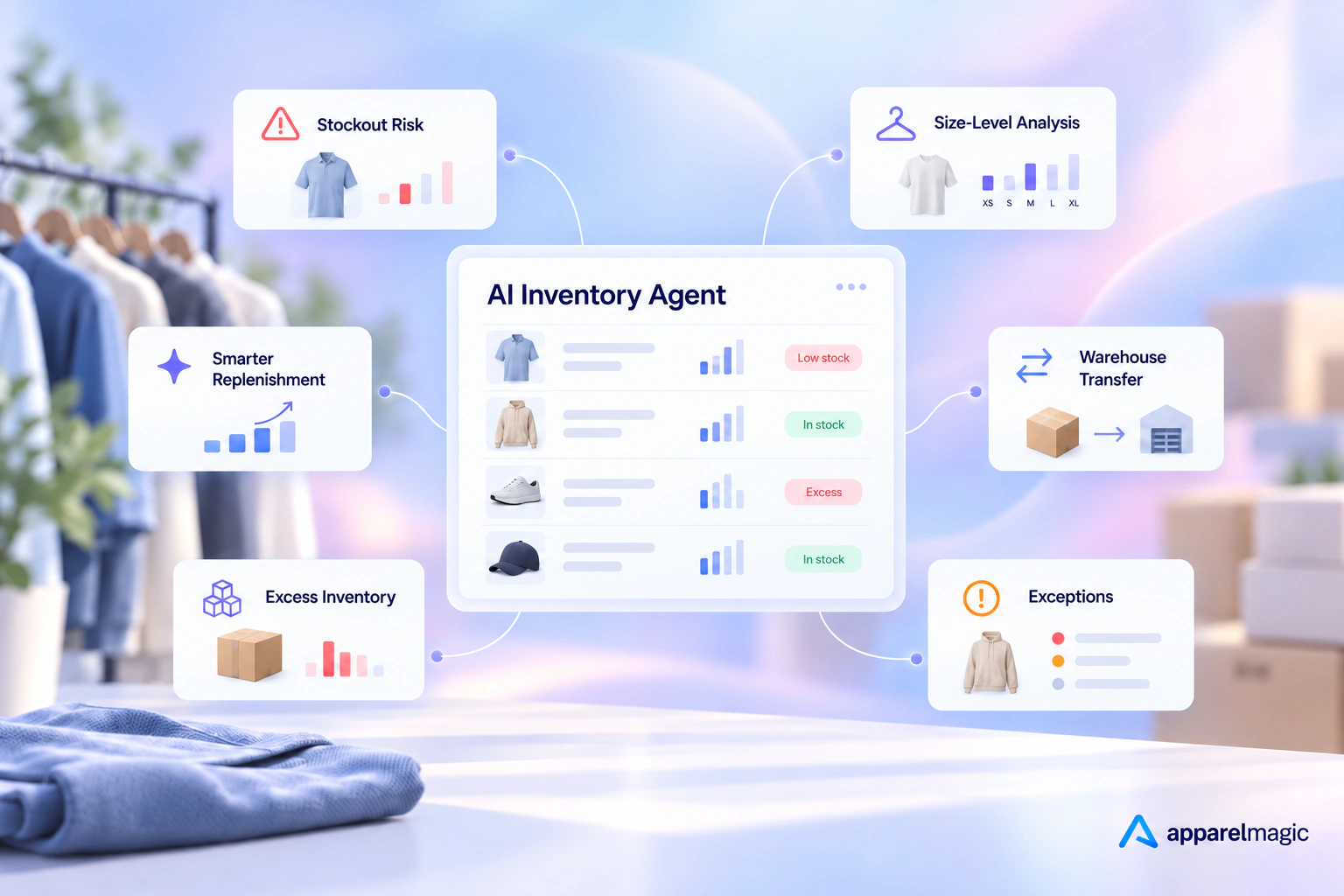
Inventory teams often perform the same checks over and over: reviewing reports each morning, checking incoming supply throughout the week, and looking for changes that require attention. The challenge is not always knowing what to look for – it is making sure those checks happen consistently as inventory conditions change.
AI Inventory Agents change that workflow by taking on more of the recurring monitoring itself. Instead of relying entirely on someone to remember when to run a report or review a condition, teams can define what the agent should watch, how often it should check, and which results should trigger a next action.
What Is an AI Inventory Agent?
An AI Inventory Agent is an AI system that repeatedly monitors defined inventory conditions, evaluates new or changing operational data, and surfaces results when those conditions require attention.
What makes the agent different is that it does not have to wait for a user to begin each analysis. It can be assigned a recurring job, such as checking a condition every morning, reviewing changes at the end of each day, or monitoring a specific workflow throughout the week.
For apparel teams, this creates a way to turn inventory checks that already happen repeatedly into more persistent, automated workflows.
From Manual Checks to Continuous Monitoring
Traditional inventory analysis usually begins when someone opens a report, dashboard, or spreadsheet and starts looking for a problem. AI Agents allow that sequence to start earlier.
A team might normally review open demand each morning, check incoming supply several times during the week, and revisit specific inventory conditions before placing new purchase orders. Instead, those reviews can become scheduled agent jobs that run according to the cadence the team defines.
The agent performs the initial check, evaluates the latest data against the assigned conditions, and brings forward the results that meet the criteria.
This means the team no longer has to initiate every recurring review manually. Their workflow can begin with the output of the check rather than with the process of gathering the information.
What Should an Inventory Agent Monitor?
The best conditions for an AI Inventory Agent are usually repeatable, measurable, and tied to a clear reason for review.
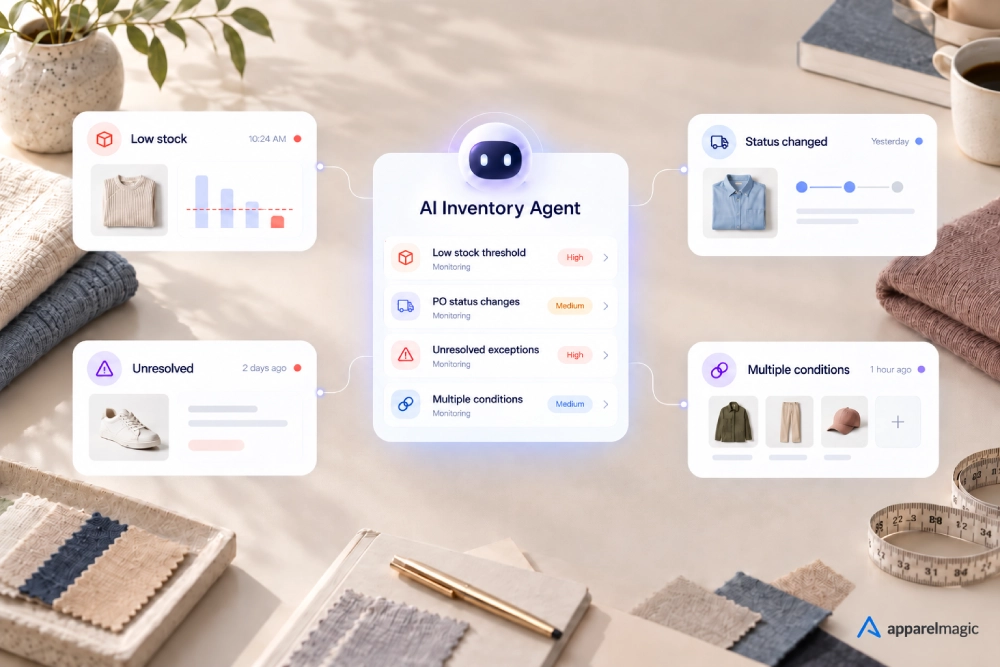
Rather than asking an agent to broadly “watch inventory,” teams can define more specific jobs. An agent might monitor whether a value crosses a threshold, whether a condition has changed since the previous run, whether an unresolved exception is still active, or whether several operational conditions occur at the same time.
For example, a team might want an agent to identify inventory records that newly meet its internal risk criteria, detect purchase orders whose status has changed since the previous check, or bring forward exceptions that remain unresolved after a defined period.
The more clearly the monitoring job is defined, the easier it becomes for the agent to distinguish normal activity from something that deserves attention.
Scheduled Jobs and Exception-Based Monitoring
Scheduling is one of the main characteristics that separates an agent workflow from one-time AI analysis.
An inventory agent can be assigned to run at a specific cadence, such as every morning, every Friday, or after another recurring operational process. Each run can review the latest state of the relevant data and determine whether anything now meets the conditions defined by the team.
The agent should not necessarily return every record it reviews. A more useful workflow is exception-based, where it evaluates the broader dataset but surfaces only the records that meet the criteria, changed meaningfully since the last review, or require some form of follow-up.
This creates a much more focused starting point for planners. Instead of repeatedly scanning the same information, they can begin with what the agent identified during its latest run.
Benefits of AI Inventory Agents
The main advantage of an AI Inventory Agent is that important inventory checks no longer depend entirely on someone remembering to perform them.
Key benefits include:
- Continuous monitoring of recurring inventory conditions
- More consistent execution of daily, weekly, or event-based checks
- Less time spent manually reopening the same reports
- Faster identification of meaningful changes between reviews
- Exception-based workflows that surface only records matching defined criteria
- More time for planners to investigate and act instead of initiating the analysis themselves
This makes an agent different from one-time AI analysis. The value is not only in interpreting inventory information, but in repeatedly performing a defined job and bringing the relevant result forward when the conditions are met.
Human Review Is Part of the Workflow
An agent workflow should also define what happens after an exception is identified.
Some results may only need to be surfaced for awareness. Others may require a planner to review the supporting information and approve a next step. In lower-risk workflows, teams may eventually allow certain actions to happen automatically when clearly defined conditions are met.
For example, one agent job might simply summarize exceptions, while another might prepare a suggested action for approval. The appropriate level of automation depends on the workflow, the consequences of the action, and how much control the team wants to retain.
This makes human review part of the agent design rather than something added after the monitoring has already been automated.
Why Inventory Agents Need Current ERP Data
Because an agent runs repeatedly, the quality and accessibility of its underlying data are especially important.
Each run needs access to the current operational state so the agent can evaluate what changed, compare conditions with the previous review, and determine whether the criteria have been met. If the information is incomplete, delayed, or disconnected from the operational system, the monitoring process becomes less useful.
This is one reason inventory agents can be especially valuable when they operate directly within or alongside the ERP. The agent can work from the same current records the business is already using rather than depending on someone to prepare a new export before every check.
Where to Start With AI Inventory Agents
The best place to introduce an AI Inventory Agent is usually a recurring check that the team already understands well.
Start by looking at the work that happens on a predictable schedule. Which reports are opened every morning? Which conditions are reviewed each Friday? Which checks happen after a major sales period, a warehouse update, or an incoming shipment?
From there, define what the agent should evaluate, how often the job should run, what qualifies as an exception, and what should happen when that exception is found.
Starting with an existing workflow also makes the agent easier to evaluate. The team already knows what a useful result looks like and can compare the agent’s output with the process it previously handled manually.
Final Thoughts
AI Inventory Agents give apparel teams a way to turn recurring inventory checks into ongoing operational workflows.
Rather than asking someone to repeatedly initiate the same analysis, an agent can run according to a defined schedule, evaluate current conditions, identify meaningful changes, and surface the exceptions that require attention.
The best starting points are usually not the most complex inventory problems. They are the recurring checks that already have a clear purpose, reliable data, defined criteria, and an obvious next step when something changes.
ApparelMagic brings this type of workflow into the same environment where teams already manage inventory, orders, purchasing, warehouses, and product data. Through ApparelMagic Intelligence, AI Agents can work with that operational context to support recurring monitoring without requiring teams to continually rebuild the same analysis from scratch.