Enterprise fashion operations require more than basic transaction management. As more brands, channels, warehouses, teams, suppliers, currencies, and systems become part of the business, the ERP needs to keep those moving parts connected without losing visibility or control.
ApparelMagic is apparel-focused enterprise resource planning software built to support enterprise fashion operations across products, inventory, sales, purchasing, manufacturing, finance, teams, warehouses, and connected systems.
Its enterprise value comes from combining apparel-specific workflows with stronger permissions, integrations, financial controls, multi-channel operations, manufacturing capabilities, and AI-driven workflows inside the same operational environment.
One Operational Foundation Across Teams
Enterprise complexity often appears when departments begin solving the same business from different systems. Sales maintains one view of customer activity, inventory works from warehouse reports, purchasing tracks incoming supply, product teams manage style information elsewhere, and finance has their own set of numbers to reconcile.
For an enterprise fashion organization, that matters because a single transaction can affect several departments at once. A large wholesale order can change available inventory, influence replenishment, create a customer commitment, and eventually affect invoicing and margin.
ApparelMagic brings those workflows into a shared operational foundation. Styles and SKUs connect with inventory, sales orders, purchase orders, customers, vendors, warehouses, manufacturing, and financial activity, so teams do not have to rebuild the relationships between those records every time they need to make a decision. This also helps eliminate double entry, as information flows across connected workflows. Many transactions also have a direct impact on the general ledger (GL), ensuring operational and financial records stay aligned.
User Groups and Permissions for Enterprise Control
A larger organization cannot operate with one level of access for everyone. Warehouse employees may need inventory and order information but not margin data, finance needs access to costs and receivables, sales teams need customer and order visibility, and administrators require broader control over configuration and permissions.
ApparelMagic uses user groups and permissions to control which parts of the ERP different users can access and what they are allowed to do. This allows access to be structured around the responsibilities of each team rather than giving every user the same view of the system.
Those controls can also extend across different types of users and business structures. ApparelMagic’s Vendor Access Portal can give vendors access to purchase orders, files, and tech packs, while sales representatives can be limited to their own customers and orders. Divisions can also help separate access across multiple brands within the same system.
The same model extends into ApparelMagic Intelligence, where AI Agents can be assigned user groups and operate within those permissions, allowing automated workflows to follow the same access structure used across the ERP.
Multi-Channel Commerce From One Inventory Foundation
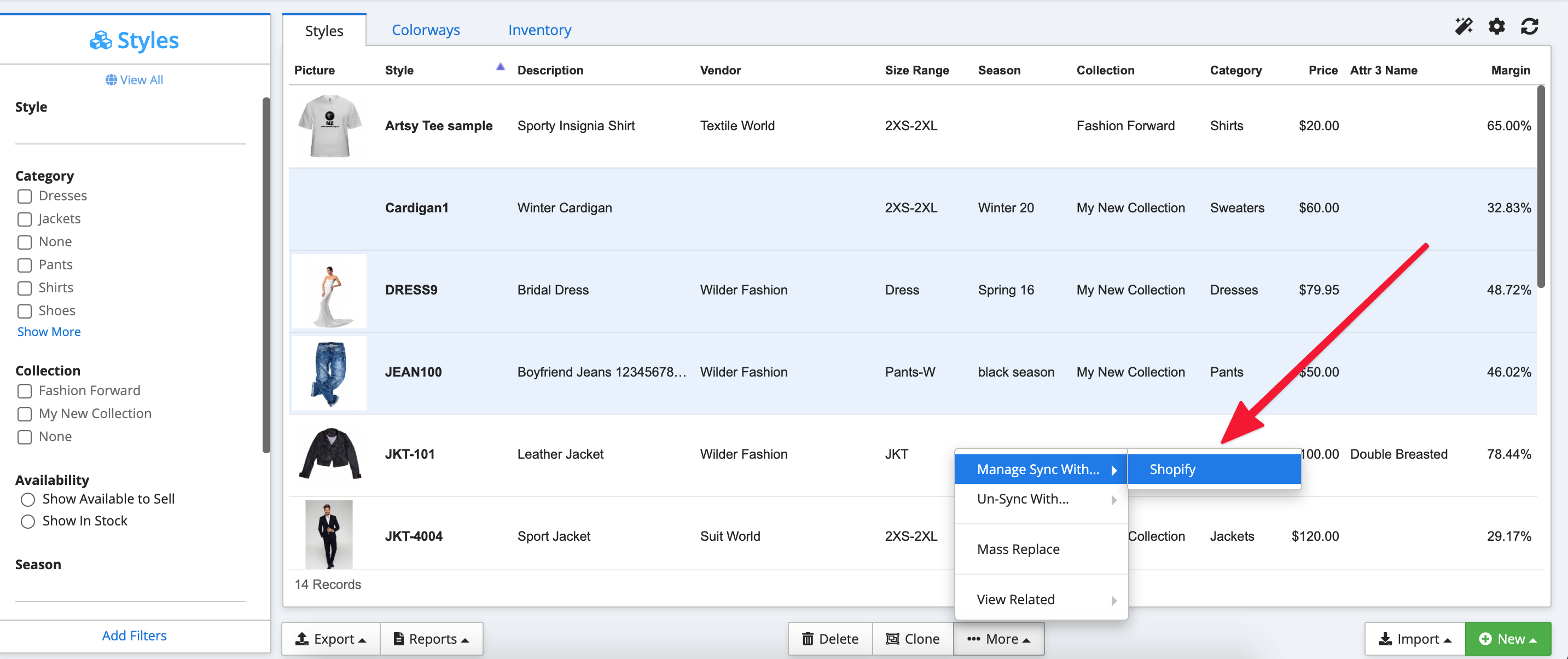
Enterprise fashion businesses often sell through wholesale, ecommerce, B2B, marketplaces, and other channels at the same time. ApparelMagic can support ecommerce operations such as Shopify while also supporting wholesale and B2B workflows against the broader product, order, and inventory structure in the ERP.
This helps teams maintain a more consistent view of availability and commitments across channels rather than allowing every sales channel to become its own isolated inventory environment.
For apparel companies, that shared inventory foundation is especially important because the same style, color, and size combinations may be committed across multiple channels. Teams need visibility into what is available, what is incoming, and what has already been promised.
Connecting ApparelMagic Across the Enterprise Technology Stack
Enterprise fashion organizations rarely operate from a single platform. Ecommerce, wholesale, fulfillment, accounting, warehouse systems, analytics tools, and collaboration platforms may all need to exchange information with the ERP.
ApparelMagic supports that broader technology environment through native integrations, an Open API, Model Context Protocol (MCP), and 3PL connectivity.
Native integrations include Shopify for ecommerce, JOOR and NuOrder for wholesale, ShipStation for shipping and fulfillment, QuickBooks and Xero for accounting, and Slack for notifications and collaboration. 3PL Connect extends connectivity into warehouse and WMS environments, including platforms such as ShipHero.
The Open API gives enterprise organizations additional flexibility to build custom integrations, connect internal applications, and support specialized workflows beyond the native integration set.
ApparelMagic MCP adds another layer by giving compatible AI applications and agents a structured way to work with approved ERP data and capabilities.
Together, native integrations, 3PL Connect, the Open API, and MCP allow ApparelMagic to remain connected to a broader enterprise technology stack as additional systems, partners, and workflows are introduced.
Multi-Currency and Financial Operations
Enterprise fashion businesses often need to understand financial performance across different customers, vendors, markets, and currencies. ApparelMagic supports financial workflows alongside operational records, including margins, receivables, payables, costs, customer activity, vendor information, and multi-currency operations.
Keeping those areas connected means financial analysis can remain tied to the transactions creating the numbers.
Teams can evaluate product performance with cost and margin context, understand customer activity alongside receivables, or review purchasing decisions with visibility into inventory and financial implications.
For enterprise teams, this creates a closer connection between the operational side of the business and the financial processes used to understand performance.
Manufacturing and Purchasing Stay Connected
For apparel companies involved in production, enterprise operations often extend well beyond finished-goods inventory. Teams may be coordinating styles, suppliers, purchase orders, production activity, incoming supply, costs, and delivery expectations across multiple vendors or regions.
ApparelMagic keeps manufacturing and purchasing connected with the same product, inventory, order, and vendor records used throughout the ERP. That allows production and purchasing teams to work from the same operational foundation as sales, inventory, and finance rather than maintaining a separate planning environment.
This becomes particularly useful when something changes. A production delay can affect incoming inventory, wholesale deliveries, customer commitments, and future availability, so keeping those workflows connected helps teams understand the wider operational impact.
Supporting Multi-Brand and Complex Organizations
Enterprise fashion organizations may operate multiple brands, divisions, warehouses, or specialized teams within the same broader business.
ApparelMagic combines shared ERP data with user groups, permissions, reporting, integrations, and operational modules to support that organizational structure. Leadership can maintain broader visibility while individual teams work within the records and workflows relevant to their responsibilities.
The objective is not to force every part of the organization to operate identically. It is to keep different teams working from the same underlying business structure while preserving the access and workflow differences required across the organization.
AI and Automation With ApparelMagic Intelligence
Enterprise operations can generate more information than teams have time to review manually. ApparelMagic Intelligence extends the ERP with AI capabilities that work with the operational data already inside ApparelMagic.
AI Agents can monitor recurring conditions on a schedule, while ApparelMagic Copilot can help users query data, run reports, and work with records on demand. Custom Agents allow organizations to define recurring workflows around their own instructions and operating rules.
Governance remains part of the model. Agent actions require approval by default, while administrators can selectively introduce auto-approval as specific workflows become trusted.
For enterprise organizations, this creates a way to expand automation without separating AI from the ERP data, permissions, and workflows already used across the business.
Keeping Apparel-Specific Workflows at Enterprise Scale
Enterprise growth does not remove the apparel-specific requirements behind the operation.
Styles still have colors and sizes. Inventory still has commitments. Wholesale orders still interact with ecommerce demand. Manufacturing, seasonal collections, purchasing, and product development still depend on fashion-specific structures.
ApparelMagic keeps those apparel workflows at the center of the ERP while adding enterprise capabilities such as permissions, integrations, multi-currency operations, multiple channels, financial controls, automation, and more complex organizational structures.
Its enterprise approach is therefore not simply about handling more transactions. It is about preserving apparel-specific operational depth while supporting a more sophisticated business environment.
When ApparelMagic Fits an Enterprise Fashion Operation
ApparelMagic is particularly relevant for enterprise fashion organizations that need apparel-specific ERP functionality alongside more advanced operational infrastructure.
That can include businesses managing:
- Multiple warehouses, 3PLs, and sales channels
- Wholesale, ecommerce, manufacturing, and purchasing workflows
- Multiple currencies and more complex financial operations
- Specialized teams, user groups, permissions, and approvals
- Several external platforms, integrations, and API connections
- AI-driven monitoring, automation, and recurring workflows
In these environments, ApparelMagic can serve as the operational foundation connecting apparel-specific workflows with the broader systems and controls used across the organization.
Final Thoughts
ApparelMagic supports enterprise fashion operations by combining apparel-specific ERP functionality with the controls and connectivity required by a more sophisticated organization.
User groups provide more structured access, native integrations connect key commerce and operational platforms, and the Open API, MCP, and 3PL Connect extend that connectivity across a broader technology stack. Multi-channel operations can work from the same inventory foundation, financial and multi-currency workflows remain connected to operational data, and manufacturing stays tied to products, purchasing, inventory, and orders.
At the same time, ApparelMagic preserves the fashion-specific structures enterprise teams still depend on as the organization grows. If your organization is evaluating enterprise apparel ERP software, request a demo to see how ApparelMagic can support your operation.